De-matting vs Shaving: Putting Your Dog's Welfare First (UK Guide 2025)
Folkestone Groomers Team
3 December 2025
12 min read
Affiliate Disclosure
This post contains affiliate links. If you make a purchase through these links, we may earn a commission at no additional cost to you. We only recommend products we trust and believe will be valuable to our readers.
De-matting vs Shaving: Putting Your Dog's Welfare First (UK Guide 2025)
When your dog's coat becomes matted, groomers face a difficult choice: spend time carefully de-matting, or shave the coat off entirely. Neither option is taken lightly. But here's what many owners don't realise—matting isn't just a cosmetic problem. It's a welfare issue that can cause genuine pain and lead to serious skin conditions.
Professional groomers in the UK operate under the Animal Welfare Act 2006, which places a legal duty on anyone responsible for an animal to protect it from pain, suffering, injury and disease.[1] This means groomers cannot simply brush out severe mats regardless of how long it takes—doing so would cause unnecessary suffering.
This guide explains when de-matting is appropriate, why shaving is sometimes the only humane option, and how to prevent mats from forming in the first place. If you've ever felt frustrated when a groomer suggested clipping your dog shorter than expected, understanding the welfare reasons behind that decision might change your perspective.
Disclaimer
This article is for general information purposes only and does not constitute professional veterinary or grooming advice. If your dog has severe matting, skin conditions, or health concerns, please consult a qualified veterinarian or Professional Dog Groomer for personalised guidance.
Quick Summary
De-matting works for minor tangles that can be removed in 15-20 minutes. Severe or widespread matting requires shaving because the discomfort of prolonged brushing outweighs the benefit of keeping the coat long. Your groomer isn't being difficult—they're following UK welfare law.
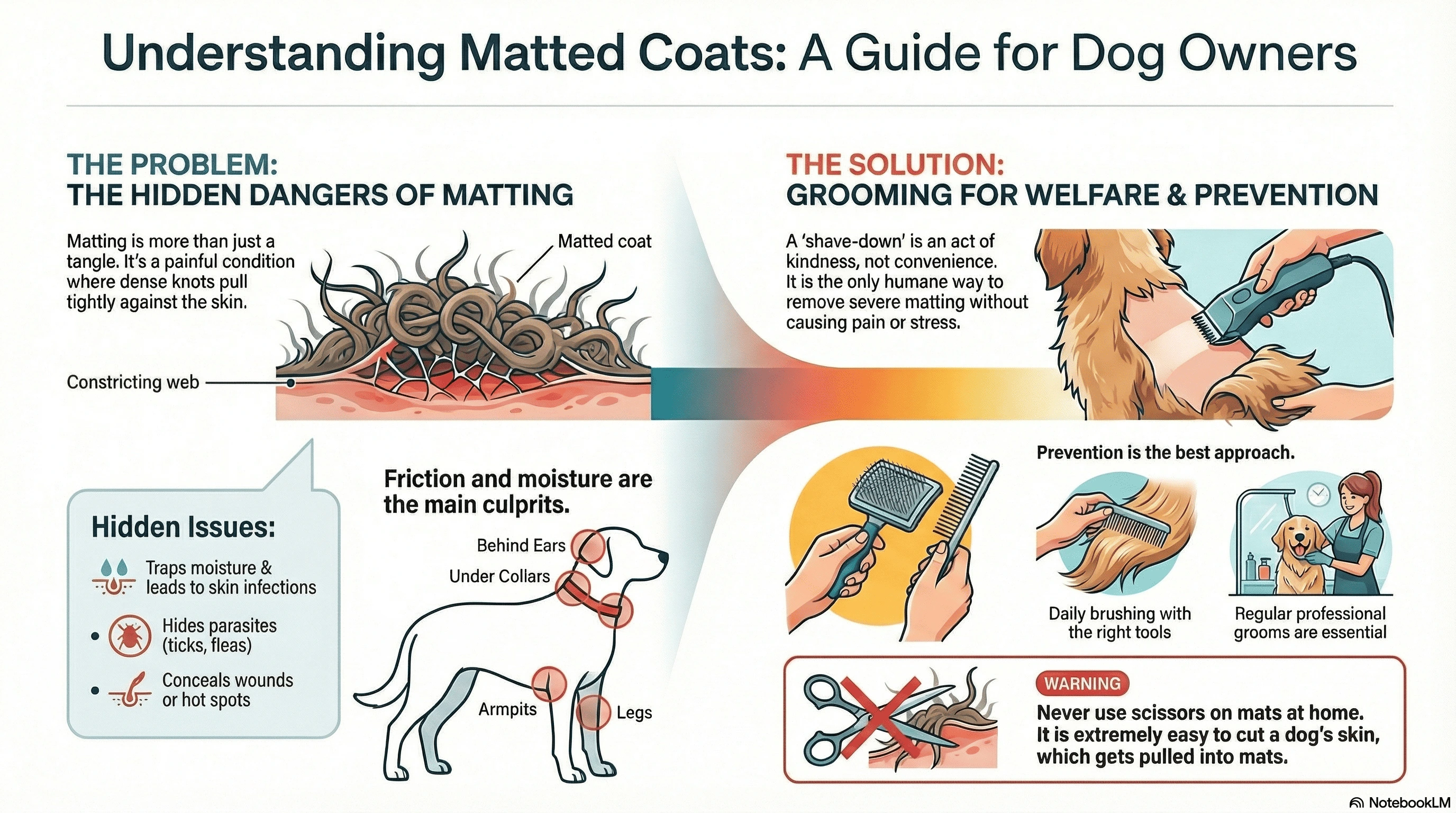
Visual guide: When de-matting is appropriate vs when shaving becomes necessary
What Is Matting and Why Does It Happen?
Matting occurs when loose fur tangles and knots together, often close to the skin. Think of it less like a simple tangle you might get in your own hair, and more like an unmaintained dreadlock that's formed by accident—tight, dense, and sitting right against the scalp.
Long-haired and curly-coated breeds are most at risk. Doodles, Shih Tzus, Bichon Frises, Poodles, and Spaniels commonly develop mats if their coats aren't maintained properly. But any dog with medium to long fur can become matted under the right conditions.
Several factors contribute to matting:
Infrequent brushing – dead hair builds up and tangles with live coat
Moisture trapped in the fur – after swimming, rain, or baths without proper drying
Friction points – areas where harnesses, collars, or the dog's body rubs together
Shedding seasons – when undercoat sheds but isn't removed, it tangles with the topcoat
Incorrect brushing technique – brushing only the surface without reaching the skin
The most common problem areas are behind the ears, under the collar or harness, along the belly and chest, around the legs, and in the armpits. These spots experience the most friction and are often missed during routine brushing.
Why Matted Fur Is a Health Risk
Matting isn't just unsightly—it can cause real harm to your dog. What starts as neglected grooming can escalate into painful skin conditions that require veterinary treatment.
Pain From Constant Pulling
Because mats form close to the skin, they pull on the hair follicles every time your dog moves. Walking, sitting, lying down—each action tugs at the tangled fur. Imagine having someone constantly pulling your hair from multiple directions. That's what a matted dog experiences all day, every day.
Skin Infections and Hot Spots
Matted fur traps moisture against the skin and prevents air circulation. This warm, damp environment is perfect for bacteria and fungi to thrive.[2] The result is often hot spots (acute moist dermatitis), yeast infections, or bacterial skin infections that cause intense itching and discomfort.
Parasites also love matted coats. Fleas and ticks can hide undetected in dense mats, biting the skin underneath while remaining invisible to owners.
Hidden Injuries and Wounds
Perhaps the most worrying aspect of severe matting is what you can't see. Cuts, scratches, rashes, and insect bites can all hide beneath matted fur. Without regular grooming, these go unnoticed until they become infected or cause significant pain. Groomers frequently discover wounds only after removing matted coats—wounds that owners had no idea existed.
Restricted Movement and Circulation
In extreme cases, matting can become so tight that it restricts blood flow. This is particularly dangerous around the legs, tail, and ears. Mats that tighten around a limb can act like a tourniquet, potentially causing tissue damage if left untreated. While rare, there have been cases where neglected matting has led to permanent injury.
Option 1: De-matting (Manual Removal)
De-matting means manually working out tangles and knots using specialised tools, scissors, or careful clipping. When it works, your dog keeps most of their coat length and you avoid the "shaved" look. But de-matting has strict limitations.
When De-matting Is Appropriate
De-matting is only suitable when:
There are only a few small mats – perhaps five or fewer isolated tangles
The mats aren't too tight – they can be teased apart without excessive pulling
Problem areas are confined – for example, just behind the ears or at the end of the tail
The work can be completed quickly – ideally within 15-20 minutes
The 15-Minute Rule
Most professional groomers in the UK follow a policy of limiting de-matting to around 15-20 minutes maximum.[3] This isn't arbitrary—it's based on the Animal Welfare Act 2006, which requires anyone caring for an animal to protect it from unnecessary suffering.
Why the time limit? Because de-matting hurts. Even with careful technique and the right tools, working out mats pulls on the skin and causes discomfort. A few minutes of mild discomfort to remove a couple of tangles is acceptable. An hour of sustained pulling and tugging crosses into cruelty.
Groomers who ignore these limits risk prosecution under animal welfare legislation. More importantly, they'd be causing genuine distress to a dog in their care—something no reputable groomer would do.
De-matting Charges
If your groomer attempts de-matting, expect an additional charge. This typically ranges from £5 to £15 for minor work, or an hourly rate of around £10-15 for more involved sessions.[4] The fee covers the extra time, specialist tools, and skill required—plus the rapid wear on equipment caused by working through tangled coats.
Amazon UK Recommendation
For minor tangles at home, a Dematting Comb with Rounded Blades can help work through small knots safely. The rounded edges protect the skin while the sharp blades cut through tangles—but remember, severe mats still need professional attention.
Option 2: Shaving (The Humane Reset)
Groomers don't shave dogs because they want to—they do it because it's the kindest option available. When a coat is severely matted, shaving is quicker, gentler, and far less stressful than hours of painful de-matting.
Why Shaving Becomes Necessary
When mats have "felted"—meaning they've knitted together into a solid mass—there's no realistic way to brush them out. The coat has essentially become a single tangled sheet sitting tight against the skin. Attempting to de-mat a felted coat would take hours and cause extreme distress.
The technical reality is straightforward: clipper blades jam on tangles. To remove mats safely, groomers need to use a blade short enough to slide between the matted coat and the skin—typically a blade that cuts at 3-5mm or shorter.[5] Anything longer won't pass through the matted areas without snagging, which hurts the dog and damages equipment.
What to Expect After Shaving
Shaving a matted coat isn't straightforward. The skin underneath is often in poor condition after being deprived of air and subjected to constant pulling. Here's what you might see:
Redness or irritation – as blood rushes back to the skin once tight mats are removed
Bruising – particularly if mats were very tight
Small nicks – even careful groomers may nick fragile, paper-thin skin hidden under mats
Itchiness – the skin is healing and adjusting to fresh air circulation
Revealed skin conditions – hot spots, sores, or infections that were hidden by the mats
Your dog may scratch or chew at the newly exposed skin. If this becomes excessive, a cone or recovery suit can prevent self-inflicted irritation while the skin settles down.
Important Note
If you notice severe redness, bleeding, or signs of infection after a shave-down, contact your vet. While minor irritation is normal, these symptoms may indicate underlying skin problems that need treatment.
Shaving Surcharges
Clipping a matted coat takes more time and skill than a standard groom, and it wears out blades quickly—dirty, matted fur dulls clipper blades faster than clean, brushed coats. Expect a surcharge on top of normal grooming fees, typically £10-30 depending on severity.[4]
This fee isn't punishment for letting the coat get matted. It reflects the genuine extra work involved: careful, slow clipping to avoid injuring delicate skin; frequent blade changes to maintain cutting efficiency; and the concentration required to navigate problem areas safely.
Warren London Hydrating Butter
If your dog's skin is dry or irritated after a shave-down, this leave-in moisturiser conditions skin and coat without greasiness. Available in soothing scents.
If you have a Pomeranian, Husky, German Shepherd, Golden Retriever, or any other double-coated breed, shaving carries extra risks. These dogs have a two-layer coat system that serves important purposes beyond looking fluffy.
How Double Coats Work
Double-coated dogs have a soft, dense undercoat that provides insulation—keeping them warm in winter and surprisingly cool in summer by trapping air. The topcoat consists of longer guard hairs that repel water, dirt, and provide UV protection.
This natural system is remarkably effective when maintained properly. The undercoat sheds seasonally (the dreaded "blowing coat" period), and regular brushing removes dead fur to keep the system working.
Why Shaving Damages Double Coats
When you shave a double-coated dog, the undercoat typically grows back faster than the guard hairs. This disrupts the natural coat balance and can result in:[6]
Patchy regrowth – the coat may come back unevenly, with some areas thicker than others
Texture changes – the new coat can feel coarser, woolier, or different from before
Colour changes – some owners report slight colour variations in regrown fur
Permanent damage – in some cases, particularly older dogs, the coat may never fully return to its original state
There's also a practical issue: a shaved double coat no longer provides proper temperature regulation or sun protection. Despite what you might think, shaving a Husky in summer doesn't keep them cooler—it removes their natural cooling system and exposes their skin to sunburn.
When Shaving a Double Coat Is Still Necessary
Despite these concerns, severe matting in a double-coated dog still requires shaving. No groomer wants to clip a double coat knowing the potential consequences—but the alternative is leaving a dog in pain with skin problems developing under the mats.
Welfare comes first. A coat will grow back. The dog's comfort and health cannot wait.
How to Prevent Matting in the First Place
Prevention is far easier than cure. With the right home care routine and regular professional grooming, most matting is entirely avoidable.
Home Brushing That Actually Works
The most common brushing mistake? Only brushing the surface. Running a brush over the topcoat might make your dog look tidy, but it does nothing to prevent mats forming underneath.
Proper brushing means working from the skin outwards:
Use a slicker brush first – work in sections, lifting the coat and brushing from the skin outward
Follow with a metal comb – if the comb glides through to the skin without catching, that section is tangle-free
Don't skip difficult areas – armpits, behind ears, under the collar, belly, and between toes are mat hotspots
Be consistent – for long-coated breeds, daily brushing is ideal; weekly at minimum
If your dog fusses during brushing, build up slowly. Short, positive sessions with treats work better than wrestling matches. Your groomer can demonstrate proper technique if you're unsure—most are happy to help. For more detail on brushing tools and methods, see our guide to brushes for shedding dogs.
Amazon UK Recommendation
For effective home brushing, the Self-Cleaning Slicker Brush makes daily coat maintenance easier. The retractable pins allow for quick cleaning, and the angled head reaches right down to the skin where mats begin.
The Comb Test
Not sure if your dog is matted? Try the comb test. Take a fine-toothed metal comb and run it through the coat, starting at the skin. If it catches, snags, or won't pass through certain areas, there are tangles forming that need attention before they become mats.
Pay particular attention to friction areas: behind the ears, under the armpits, beneath the collar or harness, and around the rear end. These spots mat fastest.
Amazon UK Recommendation
A quality Stainless Steel Grooming Comb is essential for the comb test. Look for one with both wide and fine teeth—the fine end catches even tiny tangles before they become problems.
Professional Grooming Schedules
Home brushing works alongside professional grooming, not instead of it. How often you need appointments depends on your dog's coat type and the style you want to maintain:
Short coats (Labradors, Beagles) – every 8-12 weeks for bath and brush
Medium coats (Spaniels, Setters) – every 6-8 weeks
Long or curly coats (Poodles, Doodles, Shih Tzus) – every 4-6 weeks
Fluffy styles on any coat – may need grooming every 2-3 weeks to maintain length without matting
If you want to keep a longer style, accept that it requires more frequent professional maintenance. There's no shortcut. For more on what different Dog Grooming Services involve, see our guide to dog grooming services.
After a Shave-Down: The Fresh Start
If your dog has needed a full shave due to matting, look at it as an opportunity rather than a disaster. The coat will grow back—often faster than you'd expect. Use this time to:
Establish a daily brushing routine – it's much easier on short regrowth
Book your next grooming appointment in 4-6 weeks – maintaining shorter coat is simpler
Ask your groomer for tool recommendations – they can suggest brushes suited to your dog's coat type
Consider whether you really need the long style – a shorter, more manageable clip might suit your lifestyle better
Pawdaw of London Recommendation
Make brushing easier with the Natural Conditioner & Detangler for Dogs – a leave-in formula that helps prevent tangles forming between grooms. Natural ingredients and a lovely scent make it a treat for both you and your dog.
Never Attempt to Cut Out Mats at Home
It's extremely easy to cut your dog's skin when trying to remove mats with scissors. The matted fur pulls tight against the skin, making it impossible to see where the mat ends and the skin begins. Leave mat removal to professionals who have the proper tools and training.
Frequently Asked Questions
Why won't my groomer brush out the mats instead of shaving?
Because doing so would cause your dog unnecessary pain and distress. Professional groomers in the UK are bound by the Animal Welfare Act 2006, which requires them to protect animals from suffering. Brushing out severe mats is painful—it pulls on the skin continuously for extended periods. Most groomers limit de-matting to 15-20 minutes maximum. If the mats can't be removed humanely in that time, shaving is the only welfare-appropriate option.
How long does it take for a shaved coat to grow back?
Most dogs' coats return to a workable length within 2-4 months, though full regrowth can take 6-12 months depending on the breed. Double-coated breeds may take longer, and there's a chance the coat texture could change after shaving. During regrowth, maintain a regular brushing routine to keep the new coat tangle-free.
Can I prevent matting if I bath my dog at home?
Yes, but only if you brush thoroughly before and dry completely after. Water makes existing tangles tighter and harder to remove. Always brush your dog before bathing to remove loose fur. After the bath, dry the coat completely—either with a towel and low-heat dryer, or by letting them air dry fully before brushing. A damp coat left to dry naturally can mat quickly, especially in curly or long-haired breeds. For more on home bathing, see our guide to home grooming.
My dog hates being brushed. What can I do?
Start with very short sessions and pair them with high-value rewards. Many dogs who "hate brushing" have learned to associate it with discomfort—often because previous brushing attempts involved working through tangles that hurt. Begin with just a few gentle strokes on areas your dog tolerates, followed immediately by treats. Gradually increase session length and work toward more sensitive areas over time. If your dog remains extremely stressed, discuss options with your groomer—a shorter clip that requires less brushing might be more suitable for both of you.
Is there any way to save a matted coat without shaving?
Only if the matting is minor and confined to a few small areas. A few isolated tangles can usually be teased out or carefully clipped without affecting the overall coat length. But once matting becomes widespread or the coat has "felted" (mats joined together in sheets), there's no humane way to restore it without shaving. The time and discomfort required to de-mat a severely tangled coat simply isn't worth it when the coat will grow back anyway.
Why is there a surcharge for grooming a matted dog?
The surcharge covers extra time, skill, and equipment wear. Clipping a matted coat takes longer than a standard groom because the groomer must work slowly and carefully to avoid nicking delicate skin. The process dulls clipper blades quickly—blades that cost £15-40 each to replace or resharpen. It's not a penalty; it's a fair reflection of the additional work involved. For typical grooming costs in the UK, see our pricing guide.
Between Professional Grooms?
Self-service dog washes give you professional-grade equipment (hydraulic tables, high-velocity dryers) without buying your own. Pay-per-use from £10-15.
Groomers aren't trying to ruin your dog's look when they recommend shaving a matted coat. They're making a welfare decision—one that UK law requires them to make. The choice between de-matting and shaving isn't about aesthetics; it's about what causes the least suffering.
Think of it this way: deciding between de-matting and shaving is a bit like deciding between carefully unpicking a few small tangles from a delicate necklace versus cutting gum out of a child's hair. The groomer always wants to save the necklace. But if it means causing pain, the kindest thing is the quick, clean cut.
The good news? Coats grow back. And a shave-down gives you the perfect opportunity to start fresh with a proper home brushing routine and regular professional grooming appointments. With the right maintenance, you'll never need to make this choice again.
If you're looking for a professional groomer in Kent who can help you establish a maintenance routine, check our local guides for Folkestone, Dover, Hythe, and Sandgate.
References
This guide is based on verified sources from UK animal welfare legislation, professional grooming associations, and veterinary guidance: