How to Remove Burrs, Seeds, and Sap Safely from Your Dog's Coat
Folkestone Groomers Team
4 December 2025
12 min read
Affiliate Disclosure
This post contains affiliate links. If you make a purchase through these links, we may earn a commission at no additional cost to you. We only recommend products we trust and believe will be valuable to our readers.
How to Remove Burrs, Seeds, and Sap Safely from Your Dog's Coat
⚕️ Medical Disclaimer: This article provides general guidance for at-home grooming care only. It is not a substitute for professional veterinary advice. If your dog shows signs of pain, infection, embedded grass seeds, or any concerning symptoms, consult a qualified veterinarian immediately. When in doubt, always seek professional help.
The quick answer: Use pet-safe oil (coconut, olive, or vegetable oil) to soften burrs and sap, then gently tease them out with a wide-toothed comb. Work one section at a time, keeping your hand between the skin and the debris. Never use scissors near the skin—use clippers instead if cutting is needed. Grass seeds (awns) are different and dangerous: if one has pierced the skin or entered an ear, eye, or paw, see your vet the same day.[1]
Anyone who walks their dog through meadows, woodland, or along hedgerows knows this scenario: you get home to find your dog covered in sticky debris. Burrs tangled in the feathering. Sap gluing pine needles to the paws. Maybe a grass seed lodged between the toes. These aren't just annoying—left untreated, they can cause matting, skin irritation, infection, and in the case of grass seeds, serious internal problems that require surgery.
This guide covers the three most common outdoor hazards UK dog owners face and explains exactly how to deal with each one at home. We'll also be clear about when you need professional help.
Key Takeaways: Removing Sticky Seeds, Burrs, and Sap from Dog Fur
How to remove sticky seeds from dog fur – Apply pet-safe oil (coconut, olive, or vegetable oil) to loosen the grip, then gently comb out from tip to root
How to get sap out of dog fur – Soften hardened sap with a hairdryer on low heat, work oil into the area for several minutes, then slide the sap off gradually
Never use scissors close to the skin – Use electric clippers with a guard attachment instead to avoid cutting your dog
Grass seeds are dangerous – Unlike burrs, grass awns can pierce skin and migrate internally; see a vet immediately if embedded
Prevention is key – Check your dog after every walk, paying special attention to paws, ears, and armpits during grass seed season (June–September)
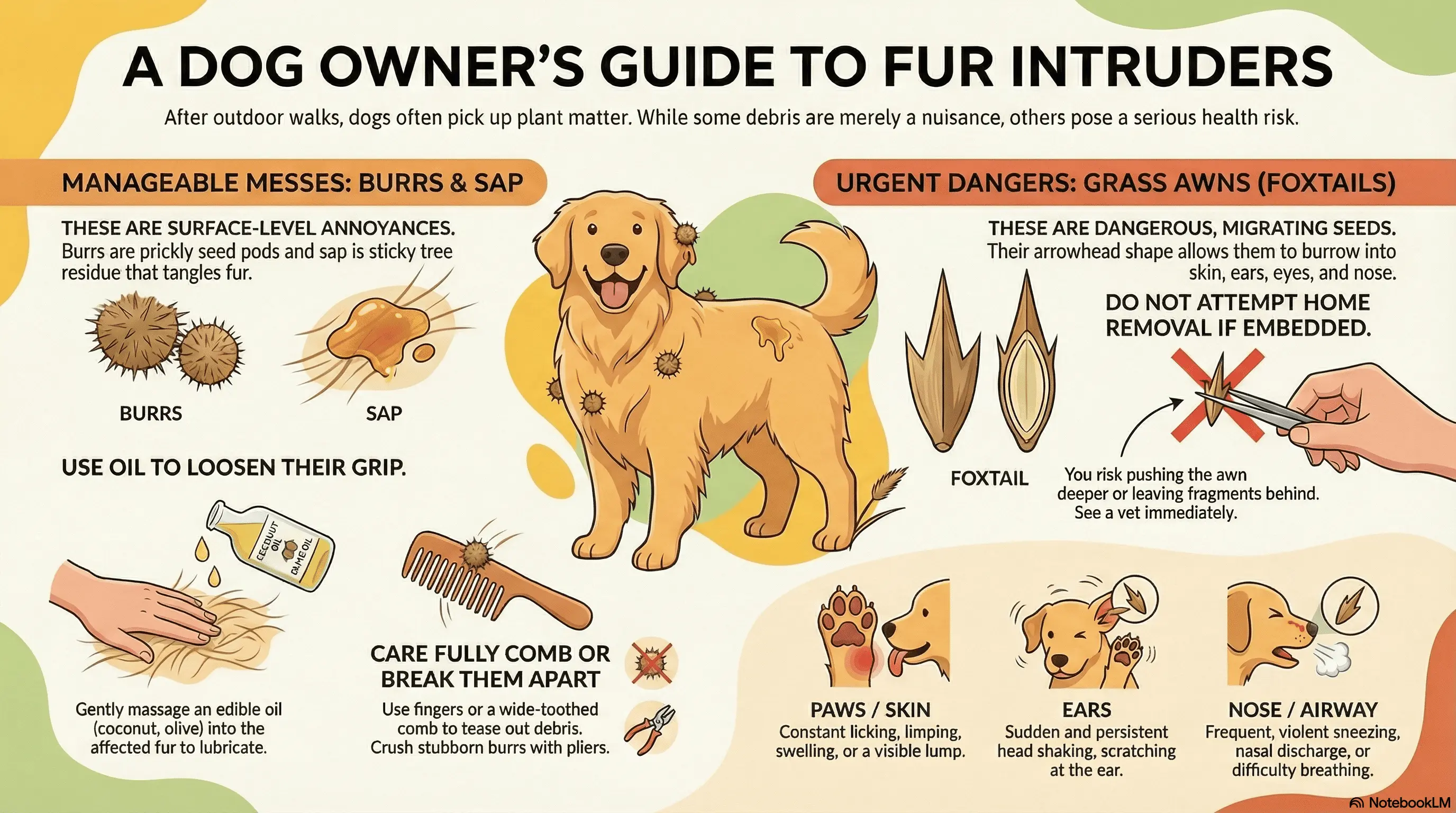
A visual guide to safe removal of burrs, seeds, and sap from your dog's coat
Between Professional Grooms?
Self-service dog washes give you professional-grade equipment (hydraulic tables, high-velocity dryers) without buying your own. Pay-per-use from £10-15.
Before grabbing the comb, it helps to know what you're dealing with. Each type of debris behaves differently and requires a slightly different approach.
Burrs and Stickers
Burrs are prickly seed pods that latch onto fur like industrial-strength Velcro.[2] They come from plants like burdock, cleavers (goosegrass), and various thistles. In the UK, you'll find them along hedgerows, woodland edges, and overgrown paths from late summer through autumn—though bramble burrs can appear year-round.
Burrs attach to the surface of the coat. They're irritating and can cause matting, but they don't typically burrow into the skin. The main risks are skin cuts from the sharp teeth, secondary infection if those cuts aren't cleaned, and severe matting if the burrs aren't removed promptly.
Tree Sap
Tree sap flows most freely during spring and early summer. Pine, spruce, and fir trees are the worst offenders. The sap itself is sticky enough to glue pine needles, dirt, and other debris to your dog's coat. If left on the skin, some types of sap can cause itchy hotspots, rashes, or allergic reactions.[3]
Sap is also mildly toxic if licked in quantity. Dogs that try to clean sap off their paws can develop stomach upset, drooling, or vomiting. While serious reactions are rare, it's best to remove sap before your dog gets a chance to ingest much of it.
Grass Seeds (Awns/Foxtails): The Dangerous One
Critical Warning
Grass awns are structurally different from burrs. Their arrow-shaped tips are designed to travel in one direction—forward—and they do not break down inside the body. Once embedded, they can migrate through tissue, causing infections, abscesses, and potentially life-threatening organ damage.[1]
Grass seed season in the UK runs from June through early autumn, with the peak danger period during the summer months.[4] The seeds come from wild grasses in meadows, long grass verges, and woodland clearings. They're particularly problematic because they're small, sharp, and designed by nature to burrow into soil—or unfortunately, into your dog.
Common entry points include between the toes, inside the ears, behind the eyelids, up the nose, and through the skin (especially in areas with thin fur like the armpits and groin). The PDSA notes that once a grass seed gets under the skin, it can start migrating around the body and become very difficult to locate.[1]
What You'll Need: Your Removal Toolkit
Before you start, gather these supplies. Having everything to hand makes the process faster and less stressful for both you and your dog.
Pet-safe oil - Coconut oil, olive oil, or vegetable oil. These are safe if your dog licks them and work brilliantly as lubricants.
Wide-toothed comb or hair pick - Metal combs with rounded teeth work best. A rotating-tooth dematting comb is even better for stubborn tangles.
Slicker brush - For finishing after the debris is out.
Gloves - Protect your hands from prickles and potential allergic reactions.
Blunt-tipped grooming scissors or electric clippers with guard - For emergency trimming only. Clippers are much safer than scissors near the skin.
Paper towels or a clean cloth - For wiping away oil and debris.
High-value treats - Keep your dog calm and reward their patience.
Soft bristle toothbrush - Useful for working oil between toes and around paw pads.
Optional but helpful: a food-filled chew toy (like a Kong stuffed with peanut butter) to distract your dog during the process, and a blow dryer on the lowest heat setting for softening hardened sap.
Amazon UK Recommendation
The Groom Professional Rotating Tooth Comb features spring-controlled teeth that retract and rotate, reducing painful pulling during burr and tangle removal. A must-have for dogs prone to picking up debris on walks.
How to Remove Burrs: Step-by-Step
The key to burr removal is patience. Rushing leads to pulled fur, nicked skin, and a dog who won't sit still next time. Here's the method that works.
Step 1: Isolate and Stabilise
Work on one burr at a time. Place your hand between the burr and your dog's skin—this protects the skin and stops the burr from reattaching as you work.[2]
Step 2: Break It Down
Large burrs are easier to manage when broken into smaller pieces. Gently crumble or split the burr with your fingers. Some people use pliers for this, but be extremely careful not to pinch the skin.
Step 3: Lubricate
Rub a generous amount of coconut oil or olive oil into the burr and surrounding fur. Let it sit for a minute or two to soften the grip. The Whole Dog Journal recommends vegetable oils because they're safe if licked and help release snarls effectively.[5]
Pawdaw of London Recommendation
For a ready-to-use solution, try the Natural Conditioner & Detangler for Dogs – a natural, easy-spray formula that loosens tangles and conditions the coat. Works on wet or dry fur and comes in recyclable bottles.
Step 4: Comb Out Carefully
Using a wide-toothed comb, start at the tips of the hair and work towards the root. Never comb from root to tip—that just tightens the tangle. Gently tease small sections at a time. If you hit resistance, add more oil and try again.
Step 5: Know When to Cut
Never use scissors close to the skin. Dr Amy Attas, a veterinarian quoted by the American Kennel Club, is clear on this point: "The only time you can use scissors for cutting your dog's fur is when you can see light between the skin and the part you want to cut out."[2]
If a burr is tightly matted near the skin, use electric clippers with a guard attachment. These are far safer than scissors because the guard prevents the blade from reaching the skin directly.
Amazon UK Recommendation
The Masterclip Cordless Dog Clippers are ultra-quiet and lightweight, making them ideal for nervous dogs. The cordless design gives you freedom to work around tricky matted areas safely.
After Removal: Check for Skin Damage
Once the burrs are out, check the skin for redness, small cuts, or irritation. Minor nicks can be cleaned with lukewarm saline solution (1 teaspoon of salt dissolved in 500ml of boiled, cooled water). Dab dry and monitor for a couple of days. If you see swelling, discharge, or signs of infection, contact your vet.
How to Remove Sticky Seeds from Dog Fur: Cleavers and Goosegrass
Sticky seeds from cleavers (also called goosegrass or sticky willy) are among the most common debris UK dog owners deal with. These small, round seeds covered in tiny hooks attach to fur in clusters and can be frustrating to remove because they grip so effectively. The Royal Horticultural Society notes that cleavers seeds frequently spread via pet fur, which is exactly why your dog seems to collect them on every walk through overgrown areas.[6]
To get sticky seeds off dog fur effectively:
Work outdoors if possible – Cleavers seeds tend to scatter when removed, and you don't want them all over your carpet
Use your fingers first – Unlike burrs, many sticky seeds can be rolled off the fur surface without needing oil
Apply detangling spray for stubborn clusters – A light mist of conditioner helps loosen the grip
Brush in the direction of hair growth – Use a slicker brush to sweep remaining seeds away once the main clusters are removed
Unlike grass awns, cleavers and goosegrass seeds don't burrow into skin—they're an annoyance rather than a medical emergency. However, if left in the coat for days, they can contribute to matting, especially in long-coated breeds like Spaniels and Setters.
How to Remove Tree Sap: Step-by-Step
Sap is a different challenge because it's not just tangled—it's glued. The approach is similar but requires more patience with the softening stage.
Step 1: Soften Hardened Sap
If the sap has hardened, use a blow dryer on the lowest heat setting to soften it. Hold the dryer at least 15cm from your dog's coat and test the temperature on your own hand first. Warm sap is much easier to remove than hard, brittle sap—but you don't want to burn delicate skin.
Step 2: Apply Oil Generously
Work a generous amount of vegetable oil, olive oil, or coconut oil into the affected area with your fingers. Some people also use smooth peanut butter (make sure it's xylitol-free—xylitol is toxic to dogs) or mayonnaise. Massage the oil in for several minutes to give it time to break down the sap.[3]
Step 3: Work It Out Gradually
Using your fingers or a wide-toothed comb, slowly work the sap out. Wipe the comb on a paper towel as you go. Don't pull or tug—if it's not coming out easily, add more oil and massage again.
Step 4: Pay Special Attention to Paws
Paws are the trickiest spot. The gaps between toes and around paw pads are hard to reach, and dogs are often ticklish about their feet. Use a soft-bristled toothbrush to work oil into these tight spaces.
Step 5: Bath Time
Once the sap is out, your dog will be greasy. Give them a bath with warm water and dog shampoo, focusing on the oily areas. You may need two washes to get all the residue out.
What to Avoid
Never use harsh chemicals to remove sap. The American Kennel Club specifically warns against astringent solvents, chemical detergents, petroleum products, and alcohol. These are harsh on sensitive skin, dangerous if licked, can irritate eyes, and often don't work as well as simple oil anyway.[3]
Dealing with Grass Seeds: When Home Removal Is (and Isn't) Safe
This is where the stakes are highest. Grass seeds require a different approach because of their ability to migrate into the body.
When You Can Remove a Grass Seed at Home
If the seed is sitting loosely in the outer fur—not embedded, not piercing the skin—you can gently remove it with tweezers. Make sure you get the whole seed out intact. Check the area carefully to ensure nothing remains.
Amazon UK Recommendation
Keep a TickCheck Premium Tick Remover Kit in your dog walking bag. The fine-tipped stainless steel tweezers are perfect for removing loose grass seeds and ticks safely. Comes with a leather case and identification card.
When You Must See a Vet
Do not attempt home removal if:
The seed has pierced the skin
You suspect a seed has entered the ear, eye, nose, or paw
There's swelling, redness, or a painful lump
Your dog is showing signs of distress (excessive licking, head shaking, sneezing, squinting)
The PDSA warns that trying to remove an embedded grass seed at home can push it deeper into the body.[1] Veterinary removal may require sedation or specialist equipment.
Recognising Grass Seed Symptoms by Location
Symptoms depend on where the seed has entered:
Ears: Sudden head shaking, scratching at the ear, sensitivity to touch, bad smell or discharge
Eyes: Squinting, excessive tearing, visible irritation, pawing at the face
Nose: Repeated sneezing (especially after being in long grass), nasal discharge, nosebleeds
Paws: Excessive licking or nibbling, limping, swelling between toes, a small lump or abscess
Skin/body: A non-healing wound, unexplained lumps, lethargy, loss of appetite, fever
If you notice any of these signs after a walk through long grass, contact your vet the same day. Early treatment is much simpler and cheaper than dealing with a migrating seed.
Prevention: Stop Problems Before They Start
A few simple habits can dramatically reduce the amount of debris your dog picks up on walks.
Check Your Dog After Every Walk
Make post-walk inspections a routine. Focus on high-risk areas: between the toes and around the paw pads, armpits, groin, tail base, ear fringes, and anywhere the harness or collar sits. The PDSA recommends checking and removing any grass seeds you find, particularly between the toes, around the armpits, and near the eyes.[1]
Keep Problem Areas Trimmed
Dogs with feathery coats (Spaniels, Setters, Golden Retrievers) or those with dense undercoats are most at risk. Regular grooming reduces matting, and keeping the fur short around paws, ears, and belly during grass seed season makes debris easier to spot and remove. For more on preventing matting, see our autumn grooming routine guide.
Choose Walking Routes Carefully
During peak grass seed season (June to September in the UK), avoid overgrown meadows and long grass where possible.[4] Stick to paths, mown areas, and beaches. This isn't always practical—country walks are part of what makes dog ownership wonderful—but awareness helps.
Use Protective Gear in High-Risk Areas
Booties can protect paws from grass seeds in dense scrub. Snoods (fabric tubes that cover the ears) are useful for long-eared breeds like Spaniels and Setters. A light mist of detangling conditioner before walks can also help reduce snagging in feathered coats.
Warren London Dematting & Detangler Spray
Professional-grade leave-in conditioner with aloe vera and jojoba oil. Loosens mats and tangles, making post-walk debris removal easier.
A well-maintained coat is far easier to check and clean than a matted one. Brushing several times a week (daily during high-risk seasons) keeps the coat tangle-free and lets you spot debris before it becomes embedded.
Amazon UK Recommendation
For daily debris checks, the Pro Slicker Brush for Long-Coated Dogs removes loose hair and surface debris while being gentle on sensitive skin. The cushioned base prevents scratching during regular grooming sessions.
When to Call Your Groomer or Vet
Book a Grooming Appointment When:
Burrs are tightly matted close to the skin and you can't safely remove them
There's widespread tangling that feels overwhelming to tackle at home
You're not confident using clippers near the skin
Your dog is highly resistant and the process is causing distress
Professional groomers have the tools and experience to handle severe matting safely. They can often work through tangles that would take hours at home, and they're skilled at keeping nervous dogs calm. If you need grooming help locally, check our guides to dog groomers in Folkestone and dog groomers in Dover.
Contact Your Vet Immediately When:
You suspect a grass seed has entered the skin or an orifice (ear, eye, nose, paw)
Your dog shows sudden symptoms after a walk: head shaking, persistent sneezing, squinting, excessive paw licking, or limping
There's swelling, discharge, or an abscess forming
Your dog shows systemic symptoms after exposure (vomiting, lethargy, difficulty breathing, loss of appetite)
A wound from burr removal isn't healing or shows signs of infection
The PDSA notes that grass seeds stuck in ears may require sedation for safe removal, and seeds embedded in paws often need surgery.[1] Don't delay—the sooner treatment starts, the better the outcome.
Frequently Asked Questions
Can I use scissors to cut out burrs?
Only if you can see clear daylight between the scissors and the skin. If a burr is caught at the end of long hairs, careful snipping is fine. But if it's close to the skin, scissors are dangerous—dog skin is thin and easily nicked, especially when pulled into a mat. Use guarded clippers instead, or book a professional grooming appointment.
Is coconut oil safe for my dog's coat?
Yes. Coconut oil, olive oil, and vegetable oil are all safe to use on your dog's fur. They're non-toxic if licked and work well as lubricants for removing debris. Just wash the oil out with dog shampoo afterwards to prevent a greasy coat.
What if my dog won't stay still during removal?
Keep sessions short and use plenty of treats. A food-stuffed toy can provide distraction. If possible, have someone else hold and calm your dog while you work. Take breaks if your dog becomes stressed—rushing leads to pulled fur and a dog who'll be even less cooperative next time.
How do I know if a grass seed is embedded?
Look for sudden behavioural changes after a walk in long grass: persistent paw licking, head shaking, sneezing, squinting, or pawing at the face. Physically, you might see swelling, a small wound that doesn't heal, or a painful lump. If you notice any of these signs, contact your vet promptly.
What's the difference between a burr and a grass seed?
Burrs are round, prickly seed pods that attach to the surface of fur like Velcro. They're irritating but don't typically burrow into tissue. Grass seeds (awns) are arrow-shaped with barbed tips that can pierce skin and migrate into the body. Grass seeds are far more dangerous and require immediate veterinary attention if embedded.
References
This guide is based on verified information from UK veterinary charities and reputable canine health sources: