Smart Dog Door UK Guide (2025): Microchip, Electronic & Large Dog Options
A smart dog door uses your pet's implanted microchip or an electronic collar key to control access—no collar tags needed for microchip models, no batteries on your dog, and no chance of losing a key. When your dog approaches, the door reads their microchip and unlocks automatically. Stray cats, foxes, and the neighbour's wandering terrier stay firmly outside.
If you're tired of playing doorman every time your dog needs to go out, these smart pet doors offer a practical solution. They're particularly useful in winter when keeping cold air out matters, or if you work from home and don't want constant interruptions. Modern microchip doors have become surprisingly sophisticated, with features like curfew timers, app control, and energy-efficient insulation that makes sense for UK homes.
This guide covers how the technology works, what to look for when buying, UK installation requirements, and which products are worth considering in 2025. We'll also address building regulations—because yes, cutting a hole in your external door does have implications.
Key Takeaways: Smart Dog Doors
- Best smart dog door for small dogs: SureFlap Microchip Pet Door (£120) uses your dog's existing microchip with no collar needed
- Best large smart dog door: PetSafe SmartDoor (up to 45kg) uses collar keys for dogs too big for microchip doors
- Best smart dog door with app control: SureFlap Microchip Pet Door Connect offers remote locking and activity notifications
- Microchip dog door size limitation: Current microchip pet doors suit dogs up to ~10kg only; larger breeds need electronic collar-key systems
- Energy efficiency matters: Look for dual or triple flap designs with magnetic closures to reduce heat loss in UK homes
Quick Note
Most microchip pet doors currently available in the UK are designed for cats and small dogs. If you have a larger breed, collar-activated electronic doors are often the better option. We cover both types in this guide.
How Smart Dog Doors Actually Work
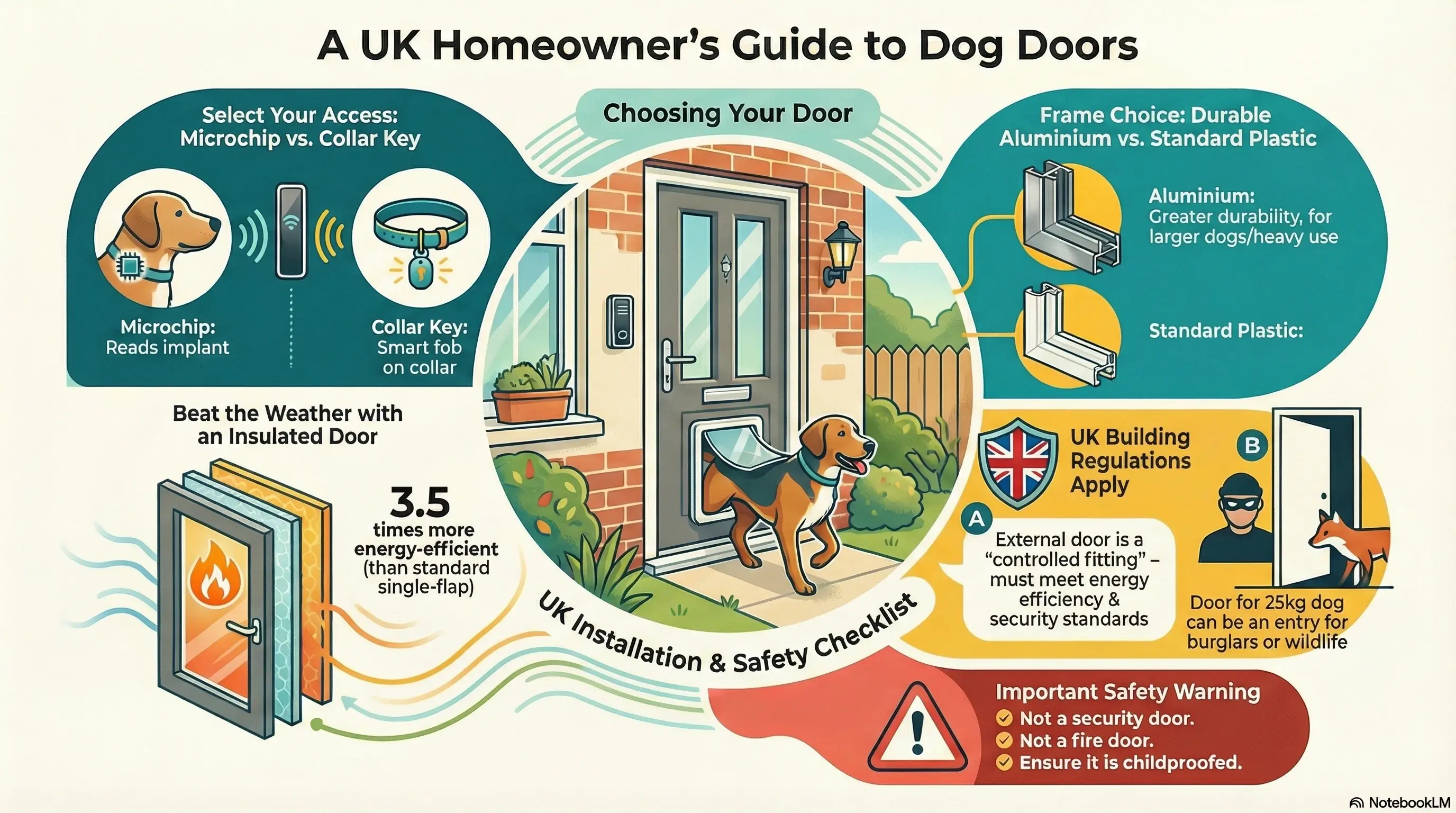
The technology behind electronic smart dog doors is surprisingly straightforward. Your dog already has a microchip—a tiny RFID (Radio Frequency Identification) transponder about the size of a grain of rice, implanted between their shoulder blades. This chip doesn't need batteries; it's powered by the scanner that reads it.
When your dog approaches a microchip pet door, an antenna in the door frame sends out a low-power radio signal. This signal activates your dog's microchip, which responds by transmitting its unique 15-digit identification number.[1] The door checks this number against its stored list of authorised pets—if there's a match, it unlocks.
The whole process takes a fraction of a second. Your dog won't notice any delay; they simply walk through. The door locks again immediately after they pass, keeping everything else out.
What About Non-Microchipped Pets?
If your dog isn't microchipped (though in the UK, dogs over 8 weeks old must be by law), most microchip doors also work with RFID collar tags. SureFlap and PetSafe both sell these tags, which attach to your pet's collar and function identically to an implanted chip.
The main brands support ISO standard 15-digit microchips (ISO 11784/11785), which covers the vast majority of chips used in the UK.[2] Some older 9 or 10-digit chips from the US may not be compatible, but if your dog was chipped by a UK vet, you're almost certainly fine.
Multi-Pet Households
One of the practical advantages of microchip doors is how well they handle multiple pets. The SureFlap Microchip Pet Door, for example, can store up to 32 different pet identities.[3] Programming is done with a single button—you put the door in "learn" mode, have each pet approach the flap, and their chip is added to the approved list.
This is where microchip doors have a real edge over collar-key systems. There's no risk of one pet borrowing another's key, no keys to lose, and no battery on your pet to run flat. The chip is implanted for life.
How microchip pet doors work: from chip recognition to secure access
Security Benefits: Keeping Unwanted Visitors Out
The main reason people buy microchip pet doors isn't convenience—it's security. A standard pet flap is essentially an open invitation to anything that can fit through it.
The Fox Problem in UK Urban Areas
Urban foxes are a genuine nuisance in many parts of the UK. They're bold, they're hungry, and they've learned that pet flaps often lead to food. Westminster Council specifically recommends using "pet flaps with electronic locking systems" to prevent opportunistic foxes from entering homes.[4]
A microchip door solves this problem. Without the right chip, the flap simply won't open—even if pushed. The locking mechanism is electronic, not mechanical, so there's nothing for a determined fox to force.
Neighbourhood Cats and Stray Animals
Cat owners know this problem well: you come home to find an unfamiliar cat has eaten your pet's food, sprayed in the corner, or started a territorial dispute. Dogs aren't immune to unwanted visitors either. Other people's cats can cause stress to indoor dogs, eat their food, or create hygiene issues.
Microchip doors stop this entirely. SureFlap markets their doors specifically on the promise that "intruder animals can't get in"—the door stays locked for any animal not in the approved list.[3]
Additional Security Features
Beyond basic access control, many smart pet doors offer features that enhance household security:
- Curfew mode - Set the door to lock automatically at night and unlock in the morning. Useful if you want your dog in after dark.
- Manual override lock - A physical switch that locks the door completely, useful when you're away or during firework season.
- Selective entry/exit - Some models (like the SureFlap DualScan) can be set to allow a pet out but not back in, or vice versa. Handy for keeping a recovering pet indoors.
- App notifications - Connected models send alerts to your phone when pets come and go, so you know when your dog last went outside.
Energy Efficiency: Why It Matters for UK Homes
A pet door is essentially a hole in your external wall or door. Without proper insulation, it's a source of draughts, heat loss, and increased energy bills. This matters more than ever with UK energy costs, and it's something building regulations take seriously.
Insulation and Draught Prevention
The best pet doors use multiple flaps and weather sealing to minimise heat loss. PetSafe's Extreme Weather doors, for example, feature a 3-flap insulation system that the company claims is 3.5 times more energy-efficient than standard single-flap doors.[5]
What you're looking for:
- Dual or triple flap design - Creates an air pocket that insulates better than a single layer
- Magnetic closures - Ensure the flap seals properly after your pet passes through
- Integrated draught excluders - Rubber or brush seals around the frame prevent air leakage
- Closing panel - A solid insert for when the door isn't in use, typically included with better models
SureFlap doors include an integrated draught excluder as standard, which helps with both energy efficiency and keeping rain out.
U-Values and Building Regulations Part L
If you're replacing an external door or having one modified, UK Building Regulations Part L (Conservation of Fuel and Power) applies. This sets standards for thermal performance, measured as U-values—the rate of heat transfer through a building element. Lower U-values mean better insulation.
While pet doors themselves aren't directly regulated, the overall performance of your external door is. A poorly insulated pet flap can compromise the thermal efficiency of an otherwise compliant door. This is worth discussing with an installer if you're having a door replaced or significantly modified.
Installation Options: Doors, Walls, and Glass
Where you install a pet door affects complexity, cost, and which products are suitable.
Wooden Doors
The simplest and cheapest option. If you're reasonably handy with a jigsaw, installing a pet door in a wooden door is a DIY-friendly project. Most products come with a template and fitting instructions. Expect to spend 1-2 hours on the job.
UPVC Doors
Common in UK homes, UPVC doors can be fitted with pet flaps but require more care. The usual approach is to cut into a solid UPVC panel—many doors have a lower panel that's suitable. Professional pet flap installers typically charge between £150 and £300 for a standard UPVC door installation.[6]
Some installers offer replacement UPVC panels with the pet flap already fitted, which they swap with your existing panel. This is cleaner and reversible if you ever want to remove the flap.
Glass Doors and Windows
You cannot cut a hole in existing double-glazed glass. A professional glazier must order a new sealed unit with the hole pre-cut at manufacture. This maintains the sealed unit's integrity and insulation properties.[7]
Glass installations are the most expensive option—expect to pay for the new glazed unit plus fitting. However, it's often the neatest solution if you have French doors or a sliding patio door.
Wall Installations
If your doors aren't suitable, going through an external wall is an option. SureFlap and other manufacturers sell tunnel extenders that work with walls of various depths—SureFlap's system handles walls up to 370mm thick.[8]
Wall installations are more invasive and expensive, typically requiring professional work to cut through brick or stone. The advantage is that you don't compromise your door at all.
Best Smart Dog Doors Worth Considering (UK 2025)
Here's an overview of the best smart dog doors available in the UK market. Prices were correct at the time of writing but check retailer sites for current costs.
SureFlap Microchip Pet Door — £120 (Best Smart Dog Door for Small Dogs)
The SureFlap is the most popular microchip pet door in the UK, and for good reason. It's the best smart dog door for large cats and small dogs (up to about 10kg), with a flap opening of 178mm x 190mm.[3]
Key features:
- Works with implanted microchips and RFID collar tags
- Stores up to 32 pet identities
- Curfew mode for automatic timed locking
- Battery powered (4 x C batteries, lasting up to 6 months)
- Integrated draught excluder
- Can be installed in doors, glass, and walls
Limitations: Too small for medium or large dogs. If your dog weighs more than about 10kg, you'll need to look at collar-activated options.
Amazon UK Recommendation
The SureFlap Microchip Pet Door is available on Amazon UK - featuring microchip recognition, curfew timer, and storage for up to 32 pets. Ideal for cats and small dogs up to 10kg.
SureFlap Microchip Pet Door Connect — £155 (Best Smart Dog Door with App)
The connected version adds app control via the Sure Petcare Hub (sold separately or in bundles). This smart dog door flap gives you remote locking/unlocking, entry and exit notifications, and the ability to set individual curfews for different pets.[3]
If you want to know exactly when your dog goes in and out—or you want to lock the door remotely when you're at work—this is the version to get. The hub also works with other Sure Petcare products like microchip feeders.
SureFlap Microchip Pet Door Connect
App-controlled smart pet door with remote locking and individual curfews
PetSafe Petporte Smart Flap — Around £80-100
The Petporte was one of the first microchip cat flaps on the market. It reads your pet's microchip without needing a collar, can store up to 25 pet identities, and includes a timer function for automatic locking at set times.[9]
Key features:
- Mains powered with optional battery backup
- Night mode and vet mode (keeps pet indoors)
- 4-way locking (in only, out only, both, locked)
- Child lock feature
- Suitable for cats up to 7kg
Limitations: Designed for cats, not dogs. The opening is too small for most dogs. Note that chips starting with certain number sequences may not be compatible—check before buying.
Amazon UK Recommendation
The PetSafe Petporte Smart Flap is available on Amazon UK - featuring microchip recognition, timer function, 4-way locking, and mains power with battery backup. Great value for cat owners.
PetSafe SmartDoor — Best Large Smart Dog Door
If you have a bigger dog, the PetSafe SmartDoor is the best electronic smart door for dogs. Unlike microchip doors, this large smart dog door uses a collar key (not your dog's implanted microchip) to trigger access. The collar key is battery-powered and lightweight.[10]
Key features:
- Available in medium and large sizes (large suits dogs up to 45kg)
- Supports up to 5 collar keys for multi-pet homes
- Motorised panel—quieter than flap-based doors
- Three modes: SmartKey only, fully locked, or unlocked
- Battery operated (4 x D cells)
The trade-off: Your dog needs to wear the collar key constantly. If the collar comes off or the key battery dies, they can't get through the door.
Amazon UK Recommendation
The PetSafe SmartDoor (Large) is available on Amazon UK - featuring collar-key activation for dogs up to 45kg, motorised panel for quiet operation, and support for up to 5 pets. The best option for larger breeds.
PetSafe SmartDoor Connected — Premium Electronic Smart Dog Door
The connected version adds app control via the My PetSafe app, allowing remote locking, scheduling, and notifications when your pet uses the smart door opener for dogs.[10]
This is currently one of the few smart dog door options that genuinely suits larger dogs while offering connected features. It's more expensive but gives you the control and monitoring that pet owners increasingly want. For homes with both large dogs and separation anxiety concerns, pairing this with a pet camera with treat dispenser creates a comprehensive pet monitoring solution.
PetSafe SmartDoor Connected
Premium app-controlled pet door with remote locking and activity notifications
UK Building Regulations and Safety Considerations
Installing a pet door in an external door or wall isn't just a DIY project—it has regulatory implications. Here's what you need to know.
Part Q: Security Requirements
UK Building Regulations Part Q sets security standards for external doors and windows. External doors should resist physical attack by opportunist burglars—typically demonstrated by meeting British standard PAS 24:2016.[11]
Adding a pet door doesn't automatically void your door's compliance, but it's something to consider. A large pet door could theoretically be exploited by a determined intruder, and the physical modification may affect the door's structural integrity.
In practice, most pet doors are too small for a person to get through. But if you're having a new external door installed and want to include a pet flap, discuss this with the installer to ensure the overall installation still meets Part Q requirements.
FENSA Certification
If you're replacing an external door or having glazing work done, the installation typically needs to comply with Building Regulations and may require FENSA certification or equivalent. FENSA covers the replacement of external windows and doors against the relevant Building Regulations.[12]
Fitting a pet flap into an existing door is generally considered a minor modification rather than a replacement, so FENSA certification shouldn't be needed. However, if you're replacing a glazed panel specifically to add a pet door, check with your installer whether certification applies.
Child Safety
This is something manufacturers mention in their safety warnings, and it's worth taking seriously. A pet door creates an opening that a small child might be able to get through, depending on the size.
If you have young children and hazards outside—a pond, pool, unsecured garden gate, or busy road—consider whether a pet door is appropriate, or use one with robust locking that children can't operate. The Petporte's child lock feature exists for exactly this reason.[9]
Safety Note
Pet doors are not fire doors. If fire safety is a concern (for example, in a door leading to an integrated garage), consult a building control officer or fire safety professional before installation.
Frequently Asked Questions
Will a smart dog door work with my dog's existing microchip?
Almost certainly yes, if your dog was chipped in the UK. The major manufacturers (SureFlap, PetSafe) support ISO standard 15-digit microchips, which is what UK vets use. You can check compatibility on the manufacturer's website by entering your dog's chip number. If you have an older non-ISO chip, you can use an RFID collar tag instead.
Are large smart dog doors available with microchip access?
Not yet, unfortunately. Current microchip-reading pet doors are designed for cats and small dogs (typically up to about 10kg). The SureFlap Microchip Pet Door has one of the larger openings at 178mm x 190mm, but that's still too small for a Labrador or German Shepherd. For larger dogs, electronic smart dog doors like the PetSafe SmartDoor are the main option, using collar keys rather than microchips.
How long do the batteries last?
SureFlap quotes up to 6 months of battery life under normal use, with an indicator light that warns you when batteries are running low.[3] The Petporte can run on mains power with an optional battery backup, which removes the need for regular battery changes. Collar-key systems like the PetSafe SmartDoor need both door batteries and collar-key batteries—the collar key typically lasts several months.
Can foxes or cats push through a locked microchip door?
No. The locking mechanism is electronic, not just a magnetic closure that can be forced. When the door is locked, it stays locked. This is the key advantage over magnetic cat flaps, which determined animals can sometimes push through.
Do I need professional installation?
It depends on your door type. Wooden doors are straightforward DIY projects. UPVC doors and glass installations typically need professional work—either a specialist pet flap fitter or a glazier. Costs for professional installation range from about £40-50 for a simple UPVC panel to several hundred pounds for glass installations.[6]
Will installing a pet door affect my home insurance?
Possibly, so check your policy. Some insurers consider pet doors a security weakness and may require them to be locked when the house is unoccupied. Electronic locking helps here—you can set the door to lock automatically at night or use the manual override when you leave. If in doubt, tell your insurer about the installation.
Final Thoughts on Smart Dog Doors
Electronic smart dog doors have come a long way from the simple swinging flaps of a decade ago. Microchip technology gives you genuine security—your dog can come and go freely while foxes, strays, and neighbourhood cats are kept firmly outside.
The main limitation remains size. If you have a small dog under about 10kg, the best smart dog door options are microchip doors from SureFlap—excellent reliability with no collar needed. For larger dogs, you're looking at electronic smart door systems like the PetSafe SmartDoor, which work well but do require your dog to wear the key constantly.
Consider your installation location carefully—wooden doors are simple, UPVC needs professional help, and glass requires a complete panel replacement. Factor in energy efficiency (look for dual or triple flap designs), and check building regulations if you're replacing an external door entirely.
Done right, a smart pet door makes life easier for both you and your dog. No more trips to the back door every time they want to go out, and no more anxious waiting by the window for them to come back in. If you're also interested in keeping an eye on your dog while you're away, consider pairing your smart door with a pet camera with treat dispenser—together they give you complete peace of mind about your pet's wellbeing.
References
This guide is based on verified sources from manufacturers, UK regulatory bodies, and independent experts: