Dog Wheelchairs & Mobility Carts: Custom vs Off-the-Shelf (UK)
Folkestone Groomers Team
15 December 2025
12 min read
Affiliate Disclosure
This post contains affiliate links. If you make a purchase through these links, we may earn a commission at no additional cost to you. We only recommend products we trust and believe will be valuable to our readers.
Dog Wheelchairs & Mobility Carts: Custom vs Off-the-Shelf (UK)
When your dog loses mobility in their back legs, a wheelchair can give them their independence back. Whether it's from degenerative myelopathy (DM), a slipped disc (IVDD), hip dysplasia, or simply old age, the right set of wheels transforms a struggling dog into one who can run, play, and explore again.
The big question most UK owners face: should you buy an adjustable off-the-shelf wheelchair or have one custom-built? Both have their place, and the right choice depends on your dog's specific situation.
This guide breaks down the differences, covers UK suppliers and pricing, and explains when each type makes sense. If cost is a barrier, we've also listed UK charities that loan wheelchairs for free.
Medical Disclaimer
This article is for general information only and is not a substitute for professional veterinary advice. Every dog's mobility needs are different, and a wheelchair should be fitted and used under veterinary guidance. Always consult your vet or a qualified canine rehabilitation specialist before purchasing or using a dog wheelchair, particularly if your dog has an underlying health condition. The charities, suppliers, and products mentioned are provided for reference—we have no commercial relationship with them and cannot guarantee their services.
When Does a Dog Need a Wheelchair?
You don't need to wait until your dog is completely paralysed. A wheelchair can help at the first signs of rear leg weakness—stumbling, dragging paws, tiring quickly on walks, or difficulty getting up from lying down.
Common conditions that lead to wheelchair use include:
Degenerative Myelopathy (DM) – A progressive spinal cord disease, most common in German Shepherds, Corgis, and Boxers. Dogs typically progress from first symptoms to needing significant support within 6–18 months.[1]
Intervertebral Disc Disease (IVDD) – Slipped or ruptured discs causing sudden or gradual paralysis. Common in Dachshunds, French Bulldogs, and Beagles.
Hip Dysplasia – Joint malformation causing pain and weakness, particularly in larger breeds.
Arthritis – Severe joint pain making it difficult for dogs to bear weight on their back legs.
Surgical Recovery – Temporary support after spinal surgery, cruciate ligament repair, or leg amputation.
Talk to your vet first. A wheelchair works best alongside proper pain management, physiotherapy, and any other treatment your dog needs. It's a mobility aid, not a substitute for veterinary care.
Types of Dog Wheelchair
Not all wheelchairs do the same job. Here's what's available:
Rear Support Wheelchairs
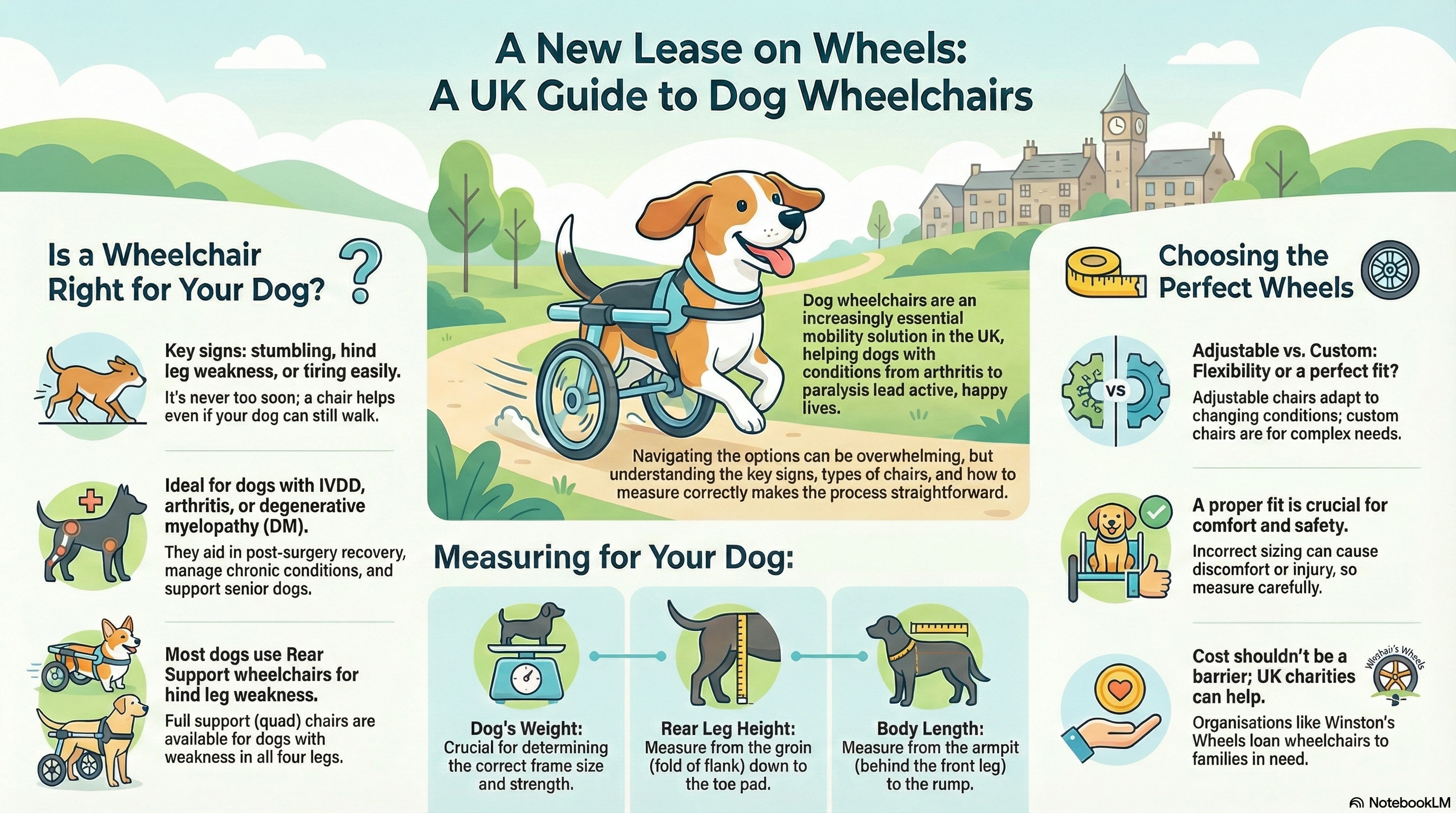
The most common type. Two wheels support the back end while your dog walks freely with their front legs. These suit dogs with hind leg weakness from DM, IVDD, hip dysplasia, or rear leg amputation—basically any condition where the front legs still work properly.
Full Support (Quad) Wheelchairs
Four wheels supporting all limbs. These are for dogs with weakness in both front and back legs—common in advanced DM or dogs with neurological conditions affecting all four limbs. Many adjustable wheelchairs can be converted from rear-support to full-support by adding a front attachment later.[2]
Front Support Wheelchairs
Rarer. These support the front legs while the back legs do the walking. Used for forelimb deformities, front leg amputees, or injuries affecting only the front end. Most UK suppliers can source these, though they're less commonly stocked.[3]
Custom vs off-the-shelf dog wheelchairs: key differences at a glance
Adjustable (Off-the-Shelf) Wheelchairs
These are the most popular choice for UK dog owners—and for good reason. Adjustable wheelchairs use modular frames that can be tweaked to fit dogs of different sizes and body shapes.
How They Work
Instead of being built to your dog's exact dimensions, adjustable wheelchairs come in set sizes (usually by weight range) with push-button or tool-free adjustment for height, length, and width. You measure your dog, order the right size, and fine-tune the fit at home.
The best-known brand in the UK is Walkin' Wheels, available through authorised resellers like Zoomadog and Wheels4Dogs. These chairs fit dogs from around 3.5kg up to 80kg+ depending on the model.[4]
Benefits of Adjustable Wheelchairs
Adapts as your dog's condition changes – If your dog loses or gains weight during rehab, or their condition progresses, you can adjust the fit. A rear wheelchair can also convert to a quad with a front attachment.
Quick delivery – Stock items ship within days. No waiting weeks for custom fabrication.
Lower cost – Generally cheaper than custom-built options, with prices starting around £199.
Replacement parts available – If a wheel wears out or a strap breaks, you can replace just that component rather than buying a whole new chair.[5]
Portable – Many designs fold flat for transport in the car.
UK Pricing for Adjustable Wheelchairs
Expect to pay between £199 and £570 for a quality adjustable wheelchair from UK suppliers like Zoomadog or Wheels4Dogs. Price depends on your dog's size—a mini wheelchair for a Chihuahua costs less than a large one for a German Shepherd.[6]
Budget options exist on Amazon and eBay for £50–£70, but these often lack proper adjustability, use flimsy materials, and can be difficult to fit correctly. Many owners who start with cheap imports end up buying a better wheelchair anyway—a false economy.
💡 Amazon UK Adjustable Dog Wheelchairs
Looking for adjustable dog wheelchairs with fast UK delivery? Amazon UK stocks a range of options for different dog sizes:
Small Dogs (Under 8kg)
Lightweight frames for Chihuahuas, Yorkies, and small breeds
Note: For best results, we recommend quality brands like Walkin' Wheels from UK specialist suppliers. Budget Amazon options vary in quality.
When Adjustable Works Best
Choose an adjustable wheelchair if:
Your dog's condition is still changing (rehab, progressive disease, recovering from surgery)
You need a wheelchair quickly
Your dog has a fairly standard body shape without significant deformities
Budget is a concern
Custom-Built Dog Wheelchairs
Custom wheelchairs are built to match your dog's exact measurements and unique body shape. Every dimension—frame width, axle position, harness configuration—is tailored specifically for your dog.
How They Work
You take detailed measurements of your dog (often 10+ different points) and submit them to the manufacturer. They fabricate the wheelchair to those exact specifications. Some measurements, particularly frame width, are welded permanently and cannot be adjusted later.[7]
The best-known custom wheelchair maker is Eddie's Wheels, a US-based company that ships internationally. They've been making custom pet wheelchairs since the 1990s and are recommended by many veterinary rehabilitation specialists.
Benefits of Custom Wheelchairs
Precision fit – Ideal for dogs with unusual body shapes, severe spinal curvature (scoliosis), multiple amputations, or congenital deformities that adjustable chairs can't accommodate.
Maximum stability – The exact fit provides a more stable platform, particularly important for dogs with advanced mobility loss who need consistent, reliable support.
Optimised for long-term use – Best for dogs whose condition has stabilised and whose size is unlikely to change significantly.
Drawbacks of Custom Wheelchairs
Higher cost – Custom chairs from Eddie's Wheels start at around $495 (roughly £390+) for rear-support and $1,200–$1,600 (£950–£1,260+) for quads, plus shipping from the US.[8]
Longer wait times – Custom fabrication takes weeks, not days. If your dog needs support urgently, this may not be practical.
Less adaptable – If your dog's weight or condition changes significantly, the wheelchair may no longer fit properly.
Measurement complexity – Getting precise measurements can be difficult, particularly with a dog who struggles to stand. You may need help from a vet or canine physiotherapist.
When Custom Works Best
Choose a custom wheelchair if:
Your dog has a fixed, severe deformity that adjustable chairs can't accommodate
Their condition has plateaued and their size is stable
You need maximum precision and stability for long-term, daily use
Budget and wait time aren't major constraints
How to Measure Your Dog for a Wheelchair
Getting the right fit is critical. A poorly fitted wheelchair can cause chafing, put strain on healthy limbs, or tip over during use. Here's what you need to know:
Key Measurements
Weight – Determines which frame size to order for adjustable wheelchairs.
Rear leg height – For Walkin' Wheels, measure with your dog lying on their side, from the crease where the thigh meets the body down to the toe pads.[9]
Length (armpit to rump) – Measured along the spine from just behind the front legs to the base of the tail.
Width – The widest point of your dog's body, usually across the hips or ribcage.
Important Note:
Different brands use different measuring methods. Walkin' Wheels measures rear leg height with the dog lying down. Eddie's Wheels requires measurements in a supported standing position. Always follow the specific instructions from your chosen supplier.
Tips for Accurate Measurements
Use a metal tape measure or rigid ruler—cloth tape measures can stretch and give inaccurate readings.
Measure on a non-slip surface so your dog feels stable.
If your dog can't stand unaided, use a support sling or harness to hold them in a natural standing position.
Take photos or videos while measuring. Many UK suppliers offer free fitting checks via email if you send them pictures and measurements.[6]
When in doubt, ask your vet or a canine physiotherapist to help—especially for custom wheelchairs where precision matters most.
UK Charities That Loan Dog Wheelchairs
Wheelchairs aren't cheap, and not everyone can afford £200–£500 upfront. Several UK charities offer free or subsidised wheelchair loans:
Winston's Wheels
A registered UK charity (1191322) that buys wheelchairs and loans them for free to dogs whose owners can't afford to purchase their own. Wheelchairs typically cost the charity £230 to £800 depending on dog size. They cover Great Britain and Northern Ireland.[10]
Charity number 1199484. They provide free wheelchair and stroller loans, plus a 24/7 WhatsApp support group for owners of disabled dogs. They also offer financial help towards veterinary treatment.[11]
Running for over 14 years, Broken Biscuits works directly with veterinary professionals to provide custom-made wheelchairs and mobility aids. They also rehabilitate and rehome paraplegic dogs, and loan wheelchairs to owners who can't afford them.[12]
Specifically for dogs with Degenerative Myelopathy. This UK-based loan service provides wheelchairs, harnesses, boots, and other mobility equipment to owners dealing with DM—a condition where equipment use can be short-lived due to disease progression.[13]
Second-hand wheelchairs – The Facebook group "UK Dogs on Wheels" has members who sometimes offer wheels they no longer need. Make sure any second-hand chair has the harnesses checked or replaced.
Veterinary rehab centres – Some offer short-term rentals for post-surgery recovery.
Training Your Dog to Use a Wheelchair
Most dogs take to wheels surprisingly quickly—some shoot off like they've been waiting their whole life. Others need a bit more patience. Here's how to make the transition smooth:
First Session Tips
Start indoors or on a flat, paved surface – Wide spaces with no obstacles work best for the first attempts.
Keep sessions short – 5 to 10 minutes initially. You're building confidence, not endurance.
Use treats and positive reinforcement – Reward any forward movement, even if it's just a few steps.
Don't force it – If your dog seems stressed or resistant, take a break and try again later.
What to Expect
Most dogs figure out the basics within a few sessions. Some dogs take off immediately. Others need a week or more to build confidence. Either is normal.
Dogs can urinate and defecate freely in most wheelchairs—the open design keeps everything clear. The chairs also handle grass, sand, gravel, and slightly uneven ground. You're not limited to pavements.
Safety Checks
Check that your dog's spine stays level—not tilting up or down at either end.
Watch for rubbing or chafing, especially around the harness straps. Adjust as needed.
Make sure the wheels roll freely and don't catch on anything.
Never leave your dog unsupervised in a wheelchair until you're confident they can manage safely.
🐕 Complementary Mobility Aids
Many wheelchair users also benefit from support harnesses for indoor use, lifting slings for getting in/out of cars, and rear leg support bands for dogs still building strength:
Several reputable UK suppliers stock quality adjustable wheelchairs:
Zoomadog – Official Walkin' Wheels stockist for over 10 years. Free fitting service via email, next-day UK delivery (£15). Prices from £199–£570. Has physios across the UK for in-person fittings.[6]
Wheels4Dogs – Another authorised Walkin' Wheels retailer with personalised fitting assistance.[4]
Silver Circle Pets – Stocks various mobility aids including wheelchairs.
For custom wheelchairs, Eddie's Wheels (US-based) ships internationally, though you'll need to factor in shipping costs and customs duties.
🏪 UK Specialist Suppliers
For expert fitting advice and quality Walkin' Wheels wheelchairs, these UK suppliers offer personalised service and next-day delivery:
Zoomadog – Free fitting service via email/phone, £199–£570
Wheels4Dogs – Authorised Walkin' Wheels retailer with fitting support
Frequently Asked Questions
Can a dog live a normal life in a wheelchair?
Yes, many dogs thrive in wheelchairs. They can walk, run, play, and explore. Dogs don't have the same emotional baggage around disability that humans often do—they just want to move. With the right support, wheelchair dogs can live happy, active lives for years.
How long do dogs with degenerative myelopathy live?
DM is progressive and currently incurable. Most dogs progress from first symptoms to significant mobility loss within 6–18 months.[1] However, quality of life during that time can be excellent with proper support, including wheelchairs, physiotherapy, and pain management. Many owners report that their dogs remain happy and engaged right up until the end stages.
Do dogs need wheelchairs permanently?
Not always. Dogs recovering from surgery (like cruciate ligament repair or spinal disc surgery) may only need a wheelchair temporarily during rehabilitation. Dogs with progressive conditions like DM will typically need ongoing support, but dogs with stable conditions (healed injuries, congenital issues) can use wheelchairs long-term with no problem.
Can I get a wheelchair on the NHS for my dog?
No. There's no equivalent to NHS provision for pets. You'll need to buy or loan a wheelchair privately. However, the UK charities listed above offer free loans if cost is a barrier.
Will my pet insurance cover a wheelchair?
It depends on your policy. Some comprehensive policies cover mobility aids as part of treatment for covered conditions. Check with your insurer—you may need a veterinary recommendation stating the wheelchair is medically necessary.
Making the Decision
Here's the short version:
Choose adjustable/off-the-shelf if your dog's condition is changing, you need something quickly, or budget is a concern. For most UK dog owners, this is the right choice.
Choose custom if your dog has a fixed, severe deformity that standard chairs can't accommodate, and you have the time and budget for bespoke fabrication.
Either way, the goal is the same: giving your dog the freedom to move, explore, and enjoy life. A good wheelchair does exactly that.
If your senior dog still has some mobility but struggles with longer walks, you might also consider an all-terrain dog stroller—perfect for dogs who can walk short distances but tire easily on family outings.
References
[1] PetMD. "Degenerative Myelopathy in Dogs." petmd.com (Accessed December 2025)
[2] Zoomadog. "Quad Dog Wheelchair by Walkin Wheels." zoomadog.co.uk (Accessed December 2025)
[3] Eddie's Wheels. "Dog Wheelchairs for Front Leg Disabilities." eddieswheels.com (Accessed December 2025)
[4] Wheels4Dogs. "Dog Wheelchairs." wheels4dogs.co.uk (Accessed December 2025)
[5] Zoomadog. "Dog Wheelchair & Dog Wheels UK." zoomadog.co.uk (Accessed December 2025)
[6] Zoomadog. "Dog Wheelchair UK - Walkin Wheels." zoomadog.co.uk (Accessed December 2025)
[7] Eddie's Wheels. "The Pet Mobility Experts." eddieswheels.com (Accessed December 2025)
[8] Eddie's Wheels. "Quads Dog Wheelchairs." eddieswheels.com (Accessed December 2025)
[9] Walkin' Pets. "How to Measure Your Pet for a Walkin' Wheels Dog Wheelchair." walkinpets.com (Accessed December 2025)
[10] Winston's Wheels. "About Us." winstonswheels.org.uk. Charity number 1191322. (Accessed December 2025)
[11] Your Dog Magazine. "Disabled Westie inspires launch of charity supporting special needs dogs." yourdog.co.uk (Accessed December 2025)