Whelping Boxes & Heated Pads: Complete Setup Guide (UK)
A whelping box is a secure, enclosed space where your pregnant dog can give birth and care for her newborn puppies. It keeps the litter contained, protects them from accidental injury, and gives mum a calm, private area during those exhausting early weeks.
Getting the setup right matters. Newborn puppies can't regulate their own body temperature for the first two weeks of life, so external heat is essential—not optional.[1] Without it, they'll chill rapidly, and a cold puppy can't digest milk properly, which puts their survival at risk.
This guide covers everything UK dog owners need to know: choosing the right whelping box, setting up heat pads safely, and maintaining a hygienic environment for your new litter. Whether you're breeding for the first time or looking to improve your setup, these practical steps will help you get it right.
Veterinary Disclaimer
This article provides general guidance only. Breeding dogs is a significant responsibility requiring veterinary support throughout pregnancy and whelping. Always consult your vet before breeding, have their daytime and emergency numbers ready, and seek immediate veterinary help if any complications arise during labour.
Choosing Your Dog Whelping Box
The right whelping box keeps puppies safe and makes your job easier. Size, material and safety features all matter.
Getting the Size Right
Your whelping box should be large enough for mum to lie fully stretched out, turn around and nurse comfortably—but not so big that puppies can wander far from her warmth.
Here's a simple measuring method: measure your dog from nose to rear while she's lying stretched out, then add 8 inches to allow for pig rails. If your dog measures 27 inches, aim for a box at least 35 inches long.[2]
The sides need to be tall enough to keep newborns contained (they'll start crawling surprisingly quickly) but low enough on at least one side for mum to step over easily without jumping.
Why Plastic Whelping Boxes Beat Wooden Ones
Plastic whelping boxes are the hygienic choice for serious breeders, and there's a good reason.
Wood is porous. It absorbs urine, blood and other fluids during whelping and the weeks that follow. Even with regular cleaning, bacteria and viruses can take up residence in cracks, crevices and the grain of the wood itself—making proper disinfection nearly impossible.[3]
Plastic (HDPE or corrugated plastic) offers a non-porous, smooth surface. You can wipe it down with disinfectant and know it's actually clean. It's also lighter to move and won't harbour the same contamination risks between litters.
Pig Rails: The Essential Safety Feature
Pig rails (also called puppy rails or anti-crush rails) are horizontal bars fitted around the inside perimeter of your whelping box, a few inches from the floor and walls.
Their purpose is simple but critical: when mum lies down against the wall, puppies can slip under the rail into the gap between rail and wall, preventing them from being trapped or crushed against the sides.[4] This won't stop mum from lying on a puppy in the middle of the box, but it eliminates the common danger of pups getting pinned against walls.
Most quality whelping boxes include pig rails as standard. If you're buying one without them, consider whether you can add them yourself—they're worth the extra effort.
Amazon UK Recommendation
For a durable plastic option with built-in pig rails, consider the EZwhelp EZclassic Whelping Box - made of tough, easy-to-clean plastic with high walls and internal safety rails. Available in multiple sizes for small to large breeds.
Where to Position Your Whelping Box
Location matters. Choose a quiet, low-traffic area of your home where mum won't be disturbed by household activity. Avoid draughty spots near doors or windows.
For UK licensed breeding premises, the whelping area must be maintained at 26–28°C.[5] Even if you're not a licensed breeder, this gives you a solid target for ambient room temperature. Remember that puppies will still need additional heat beyond this—more on that below.
Dog Heating Pads: Keeping Puppies Warm
Newborn puppies can't shiver to generate warmth or regulate their body temperature until they're around two weeks old. External heat isn't a luxury—it's survival equipment.
Heat Pads vs Heat Lamps: Which is Safer?
Heat pads are generally safer and more practical than heat lamps for most whelping setups.
Here's why:
- Uniform warmth – heat pads deliver consistent temperature across their surface, while lamps create hotspots that can overheat puppies directly beneath them
- Lower dehydration risk – infrared lamps can dry out puppies, particularly their eyes and skin, while pads don't have this effect[6]
- Temperature control – adjustable pads let you fine-tune the heat precisely, especially when coupled with a thermostat
- Safety – a heat lamp dangling above a whelping box is an accident waiting to happen if it falls or isn't secured properly
Some breeders use both—a pad for consistent base warmth and a lamp for drying newborns immediately after birth. But for ongoing heating, pads are the preferred choice.
What Temperature Do Newborn Puppies Need?
During the first four days of life, puppies need an environmental temperature of 29–32°C (85–90°F).[1]
After that first week, you can gradually reduce the temperature:
- Week 1 – 29–32°C (85–90°F)
- Week 2 – 27°C (80°F)
- Weeks 3–4 – 24–27°C (75–80°F)
- Week 5 onwards – 21°C (70°F) minimum
One important note: a heating pad may not feel particularly warm when you touch it with your hand. These pads are designed to work with body weight and combined heat. To test properly, place a cushion or heavy blanket on the pad for 30–60 minutes, then check the temperature underneath.
Heat Pad Safety Features to Look For
Never use human electric blankets for puppies. They heat too high and lack the safety features needed around animals. Pet-specific heating pads are designed with lower, safer temperature ranges.
When buying a heating pad for your whelping box, look for:
- CE or UKCA certification – confirms the product meets UK safety standards[7]
- Chew-resistant cord – stainless steel or armoured cable protects against curious pups once they start teething
- Waterproof surface – rated IP67 or higher is ideal; accidents will happen and you need to protect against electric shock
- Overheat protection – internal thermostats that automatically cut power if the mat exceeds safe temperatures
- Adjustable temperature – allows you to reduce heat as puppies grow
Amazon UK Recommendation
The Pecute Dog Heat Pad (40x50cm) features constant temperature safety, anti-bite waterproof construction, and flame retardant cotton—ideal for whelping boxes. Soft cosy heated design perfect for keeping puppies warm.
Placing Your Heat Pad Correctly
The golden rule: never cover more than half the floor space with heat.
Puppies (and mum) must be able to move away from the heat source if they're too warm. If the entire box is heated, they've got nowhere to go to cool down.
Place the pad:
- Under the whelping box or beneath a layer of bedding—not in direct contact with puppies' skin
- On one side only, leaving the other half unheated
- Away from the entrance, so mum doesn't have to step on it every time she gets in or out
Always use a barrier between the pad and puppies—a whelping pad, vetbed or fleece layer will diffuse the warmth and prevent any direct contact irritation.
Petnap UK - Specialist Whelping Supplier
UK manufacturer of metal pet heat pads since 1973, plus whelping boxes, kits and accessories
Maintaining Hygiene in the Whelping Box
A clean whelping environment protects puppies from infection during their most vulnerable weeks. This means daily attention to bedding, regular disinfection, and constant monitoring.
Bedding Management
Use flat, absorbent bedding that puppies can't burrow under.
Vetbed (synthetic fleece with a rubber backing) is popular because it wicks moisture away from the surface and lays flat. Towels work too, but must be changed frequently. Whichever you choose, avoid piling up blankets or loose fabric—puppies can crawl underneath and risk suffocation or being crushed when mum lies down.
During the first few weeks, expect to change bedding several times daily. Keep a stack of clean bedding ready and a separate basket for soiled items awaiting the wash.
Tip: Layer puppy pads or newspaper over your main bedding during the birth itself. You can quickly remove and dispose of soiled layers without disturbing the base bedding underneath.
Wash bedding with a pet-safe, fragrance-free laundry detergent. Strong perfumes can confuse puppies who navigate by scent to find mum.
Amazon UK Recommendation
For whelping bedding, Vet Fleece Original Greenback Bedding is a breeder favourite—it wicks moisture away from the surface, lies flat so puppies can't burrow underneath, and machine washes beautifully. Quick-drying and durable.
Cleaning and Disinfecting the Box
Regular cleaning keeps bacteria at bay. Use a pet-safe, puppy-safe disinfectant—many are available from veterinary suppliers or pet shops.
Avoid bleach and harsh chemicals. Even diluted bleach can leave residues that irritate delicate puppy skin and mucous membranes. The fumes alone can be harmful to newborns.
After cleaning, make sure the box is thoroughly dry before returning mum and puppies. Dampness plus warmth creates ideal conditions for bacterial growth—the opposite of what you want.
Daily Safety Checks
Supervision saves lives. Never leave a heat pad running unattended with puppies if you can avoid it, and carry out these checks every day:
- Inspect cables – look for any chewing damage, exposed wires or fraying
- Check the pad surface – make sure it's intact and not damaged
- Watch for overheating signs – excessive panting, restlessness, or puppies actively moving away from the heat zone
- Unplug immediately if damp – if accidents have soaked through to electrical components, cut the power first
When to Call Your Vet
Have your vet's daytime number and out-of-hours emergency line saved in your phone before whelping begins. Some situations require immediate professional help.
Contact your vet urgently if:
- Mum has been straining for 20–30 minutes without producing a puppy[8]
- You see thick green discharge with no puppy arriving
- More than 2 hours have passed between puppies during active labour
- A puppy appears stuck or only partially delivered
- Mum is exhausted, collapsed or showing signs of distress
- Any puppies are fading, cold, or failing to feed
It's always better to phone and check than to wait and hope. Vets expect calls during whelping and would rather advise that everything's normal than be called too late.
UK Legal Requirements for Breeding Dogs
If you breed dogs in England, certain rules apply under The Animal Welfare (Licensing of Activities Involving Animals) (England) Regulations 2018.
Key points to know:
- Puppies cannot be sold or permanently separated from their mother before 8 weeks old[9]
- When showing puppies to prospective buyers, the mother must be present
- Licensed breeding premises must maintain whelping areas at 26–28°C[5]
- You may need a breeding licence if you breed three or more litters per year, or if you sell any puppies commercially
Different rules apply in Scotland, Wales and Northern Ireland. Check with your local council if you're unsure whether licensing applies to you.
Frequently Asked Questions
How warm should a whelping box be for newborn puppies?
The puppies' area should be 29–32°C (85–90°F) during the first week of life. This can be reduced gradually to around 24°C (75°F) by week four. Remember, puppies can't regulate their body temperature initially—if a newborn's body temperature drops below 34°C, it loses the ability to digest milk properly, which can be fatal.[10]
What size whelping box do I need?
Measure your dog from nose to rear while lying stretched out, then add at least 8 inches for pig rails. The box should give mum enough room to lie fully extended and turn around comfortably, but not be so large that puppies can crawl far away from her warmth. For large breeds or big litters, go up a size to allow extra space.
Are heat lamps or heat pads better for puppies?
Heat pads are generally safer for ongoing heating. They provide uniform warmth without the dehydration risk that heat lamps can pose. Lamps also create hotspots and are potential fire or falling hazards if not secured properly. Some breeders use lamps briefly for drying newborns after birth, but pads are preferred for consistent, long-term warmth.
What are pig rails and do I need them?
Pig rails are horizontal bars fitted around the inside of the whelping box, a few inches from the floor. They create a gap between the rails and the walls where puppies can shelter if mum lies against the side—preventing her from crushing them. They won't stop every accident, but they significantly reduce the risk of pups being trapped against walls.
Can I use a wooden whelping box?
Plastic is strongly recommended over wood. Wooden boxes absorb fluids and harbour bacteria in porous surfaces and cracks, making thorough disinfection almost impossible. Plastic (HDPE or corrugated plastic) has a smooth, non-porous surface that you can properly clean between litters.
Checklist: Whelping Box Setup
Before your dog is due to whelp, run through this quick checklist:
- ☐ Whelping box sized correctly (dog's length + 8 inches minimum)
- ☐ Pig rails in place or added
- ☐ Plastic or non-porous material for easy cleaning
- ☐ Heat pad with CE/UKCA certification, chew-resistant cord and waterproof surface
- ☐ Heat pad covering no more than half the floor space
- ☐ Barrier layer (vetbed/fleece) between pad and puppies
- ☐ Thermometer to monitor temperature
- ☐ Spare bedding ready for frequent changes
- ☐ Pet-safe disinfectant (not bleach)
- ☐ Vet's daytime and emergency numbers saved in phone
- ☐ Box positioned in quiet, draught-free location
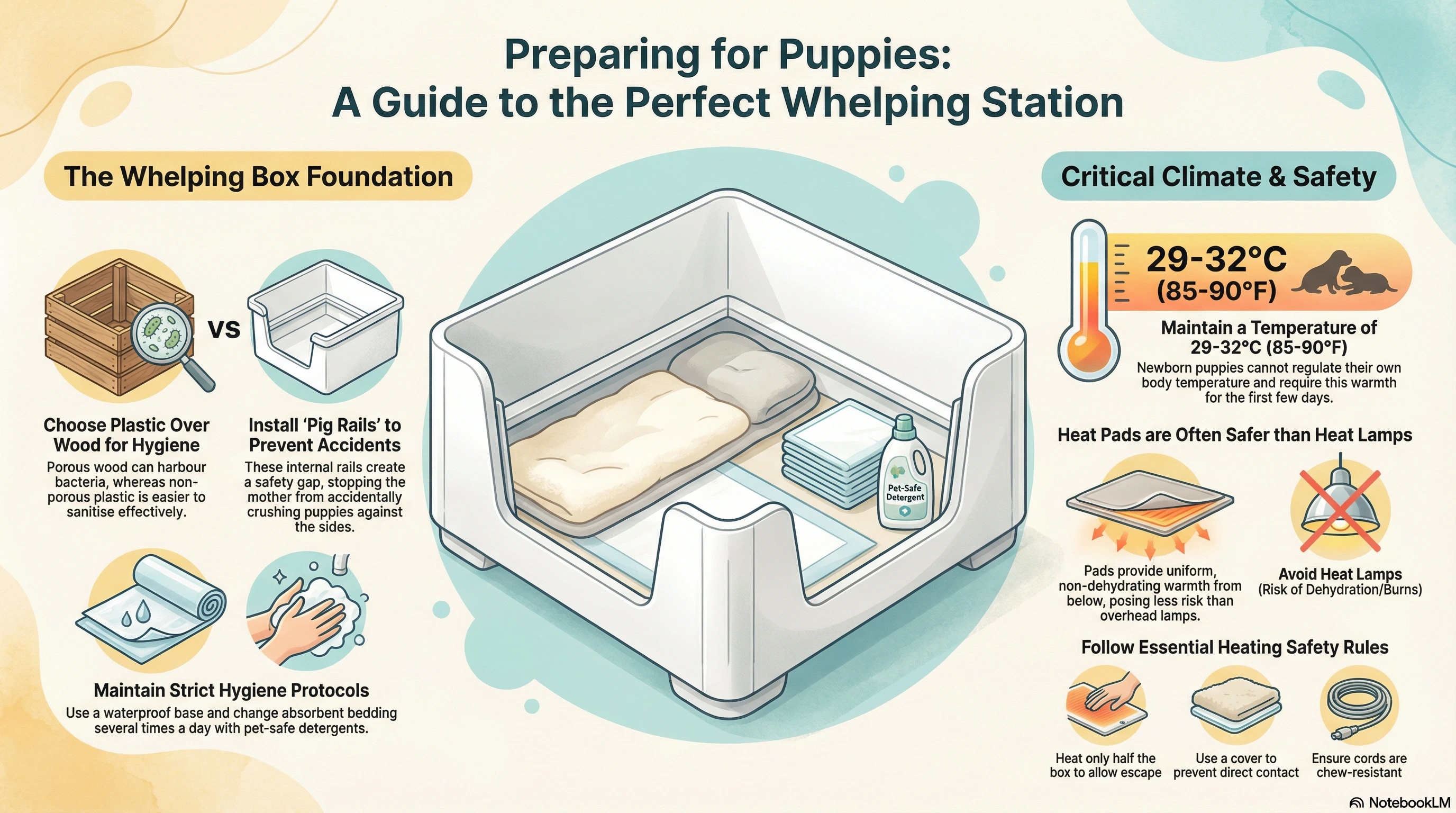
Complete whelping box setup guide with safety features and temperature zones
Final Thoughts
Setting up a proper whelping box isn't complicated, but it does require attention to detail. Get the temperature right, keep things clean, and have your vet on speed dial.
The investment in a quality plastic whelping box with pig rails will serve you for multiple litters. A reliable, pet-safe heating pad is essential equipment—not optional. And maintaining strict hygiene protects those vulnerable newborns during the weeks when they’re most at risk. For older dogs or nursing mothers who benefit from warmth, see our guide to heated dog beds for arthritic dogs.
If this is your first litter, speak to your vet well before the due date. They can advise on what to expect, when to call, and any breed-specific considerations for your dog.
References